
AI in test automation has become relevant because software systems no longer change in small, predictable steps. Modern applications are rebuilt continuously, UI layers evolve rapidly, and backend services are updated independently. In this environment, traditional automation frameworks struggle to stay stable without constant human intervention.
The core problem AI addresses is not intelligence, but resilience. Classic automation assumes that what was true yesterday will still be true tomorrow. AI-assisted automation is designed to handle constant change and reduce failures caused by minor or expected system evolution. When used correctly, this shifts automation back into being a quality signal instead of a maintenance burden. In practice, AI test automation focuses on keeping automated test suites reliable as applications evolve, rather than forcing teams to constantly rewrite scripts after every small change.
What AI in Test Automation Actually Means
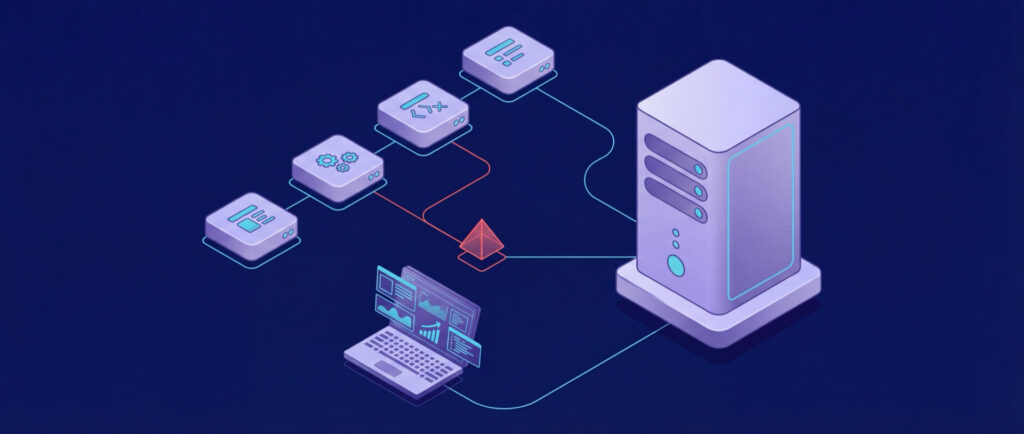
AI in test automation is an umbrella term for using machine learning techniques to improve different parts of the testing lifecycle. It does not mean that tests suddenly understand business logic or that quality decisions are delegated to models.
The key difference compared to traditional automation is how decisions are made. Instead of relying solely on exact rules, AI systems evaluate context and historical behavior. This allows automation to respond more intelligently to change.
When evaluating the best AI automation testing tools, it is important to understand which parts of the testing lifecycle AI is actually influencing.
In practice, AI is typically used to:
- Improve how elements are identified when UI structure changes but user intent stays the same. Instead of breaking on renamed classes or moved components, tests can still interact with the correct elements.
- Learn from past executions to recognize patterns, such as recurring flaky failures or environment-related issues, and reduce noise in test results.
- Assist with test generation by proposing scenarios derived from requirements, flows, or usage data, speeding up coverage expansion.
- Optimize execution by prioritizing tests based on risk, recent code changes, and historical failure data.
- Support failure analysis by correlating logs, errors, and code changes to surface likely root causes faster.
AI does not define correctness. Assertions, expected outcomes, and risk tolerance are still set explicitly by humans. AI operates inside those boundaries to make automation more sustainable.
Where Traditional Test Automation Breaks Down
Traditional automation usually works well at first and degrades over time. As systems grow and change more frequently, small issues accumulate until automation becomes fragile and noisy.
The most common breakdown points are:
- Brittle UI selectors, where cosmetic or structural changes break tests even though user-facing behavior is unchanged. This is especially common in component-based frontends.
- Flaky tests, caused by timing issues, shared environments, asynchronous behavior, or unstable external dependencies. These failures erode trust in automation results.
- Slow CI pipelines, where full regression runs delay feedback and push teams to skip or defer testing.
- High maintenance costs, where fixing tests consumes more effort than validating new functionality.
Once these problems stack up, teams adapt in unhealthy ways, which is often the point where AI test automation becomes attractive as a way to stabilize growing and fragile test suites. Failures are ignored, tests are rerun blindly, and coverage is reduced to keep pipelines moving. At that point, automation still exists, but it no longer provides reliable quality insight.
How AI Improves Test Automation Workflows

AI for test automation improves workflows by making automation adaptive instead of rigid. When a test encounters change, the system evaluates whether the change affects behavior or only implementation details.
In some teams, this also includes limited use of AI to suggest additional test scenarios or highlight potential coverage gaps, although this is typically a secondary benefit rather than the primary driver for adoption.
In real workflows, this results in:
- Tests surviving UI refactors that preserve user intent, such as layout changes or component rewrites.
- Reduced failure noise, because AI can help identify recurring environment-related issues and assist teams in distinguishing them from likely regressions.
- Longer-lived test suites, where tests remain useful across multiple iterations of the product instead of constantly breaking.
The main benefit is not fewer failures, but better failures. When automation fails, teams can trust that something meaningful has likely changed.
Self-Healing Tests and Maintenance Reduction

Self-healing tests address one of the most persistent problems in UI automation: tests breaking due to changes that do not affect real user behavior.Instead of failing immediately when a selector changes, AI powered test automation allows systems to adapt by identifying equivalent elements based on context and prior executions. This keeps automation useful during ongoing development instead of constantly requiring manual fixes.
Reduced Selector Maintenance
UI changes such as renamed classes, reordered components, or layout refactors frequently break traditional tests even when functionality remains the same. Self-healing mechanisms reduce this maintenance burden by finding alternative ways to locate elements that still represent the same user intent. As a result, teams spend less time repairing selectors and more time validating actual behavior.
Continued Test Execution During Active Development
During periods of heavy development, UI instability often causes large portions of the test suite to fail, even when core functionality is still correct. Self-healing allows tests to continue running through these changes, providing ongoing feedback instead of forcing teams to disable or ignore automation. This is especially valuable in CI/CD environments where uninterrupted feedback matters more than perfect precision on every build.
Lower Long-Term Cost of UI Automation
Over time, constant test repair becomes one of the biggest costs of UI automation. By reducing how often tests break for non-functional reasons, self-healing lowers the long-term effort required to keep large suites operational. This makes UI automation more sustainable and prevents it from being abandoned as systems evolve.
Self-healing must still be applied with discipline. It primarily applies to UI-layer tests and does not replace validation of backend logic or business rules. Healing actions should be visible and reviewable, with strong assertions in place to ensure tests still verify the correct outcomes.
Smarter Test Execution in CI/CD Pipelines

As automation suites grow, running every test on every commit becomes unrealistic. AI powered test automation helps address this limitation by prioritizing execution based on risk, recent changes, and historical failure data. AI improves execution strategy by prioritizing tests based on risk and relevance.
This typically includes:
- Running tests most affected by recent code changes first.
- Prioritizing tests with a strong history of catching regressions.
- Deprioritizing or batching low-signal tests that rarely fail.
The result is faster feedback without blindly cutting coverage. CI pipelines become more predictable, and developers receive meaningful results earlier in the process.
Failure Analysis and Debugging Support
Test execution is only part of the cost of automation. Diagnosing failures often takes longer than running the tests themselves. AI helps by analyzing failures across runs instead of treating each one as an isolated event.
This allows teams to:
- Group failures caused by the same underlying issue, even when they appear in different tests.
- Correlate failures with recent code changes or environment updates.
- Identify likely root causes faster and narrow the investigation scope, reducing time spent manually searching through logs.
AI does not replace debugging, but it significantly shortens the path from failure to understanding.
Visual Testing with AI
Traditional visual testing relies on pixel-perfect comparison, which produces excessive false positives. Minor rendering differences trigger failures even when usability is unaffected.
AI-based visual testing focuses on layout intent and structure instead of exact pixels. It can tolerate harmless variation while detecting real issues such as broken layouts, overlapping elements, missing content, or incorrect responsiveness.
This makes visual testing practical again, particularly for responsive designs and cross-browser coverage where strict comparison quickly becomes unmanageable.
Test Data Generation and Safer Testing
Test quality depends heavily on data quality. Tests that rely on unrealistic or overly simplified data often miss real-world failures, while tests that use production data introduce privacy and compliance risks. AI helps generate realistic synthetic data that reflects real usage patterns without exposing real user information, making test environments both safer and more reliable.
Coverage for Edge Cases and Data Variations
AI-generated data can produce a wide range of valid and invalid inputs based on schemas, constraints, and observed usage patterns. This helps uncover edge cases that depend on data shape, relationships, or boundary conditions rather than specific hard-coded values. As a result, tests are more likely to catch issues that only appear under less common but still realistic scenarios.
More Realistic Performance and Load Testing
Performance and load tests are only as good as the data they run against. AI-generated datasets can better approximate real-world distributions, sizes, and access patterns, leading to more accurate stress and scalability results. This reduces the risk of performance surprises that only appear after deployment.
Improved Compliance and Privacy Safety
Using production data in test environments creates legal and security risks, even when data is partially masked. AI-generated synthetic data avoids these risks entirely by producing realistic datasets that contain no real personal or sensitive information. This makes it easier to comply with privacy regulations while still testing meaningful scenarios.
Reliable synthetic data also reduces dependence on fragile shared test accounts and manually curated datasets. Tests become easier to reproduce, environments are easier to reset, and automation remains stable as systems and teams scale.
Adopting AI in Test Automation: Fit and Best Practices
AI for test automation works best when introduced to solve specific, existing problems rather than being adopted as a general upgrade. Not all AI-driven testing tools offer the same level of maturity or reliability, so teams should evaluate capabilities carefully rather than assuming uniform results. Teams usually benefit most when flaky tests, maintenance overhead, or slow pipelines are actively blocking delivery.
A practical adoption approach includes:
- Starting with a single problem area, such as unstable UI tests or slow regression cycles.
- Measuring whether AI actually improves stability, speed, or signal quality.
- Expanding gradually only when results justify the added complexity.
Guardrails are critical. High-risk workflows require stricter rules and stronger assertions, while lower-risk areas can tolerate more flexibility. Without clear boundaries, AI can hide issues instead of reducing risk.
It is equally important to recognize when AI is unnecessary. Smaller or stable applications with manageable automation may see better returns from improving test design or environment reliability rather than introducing AI-driven behavior.
Conclusion
AI in test automation is not a shortcut to quality and not a replacement for good testing practices. Its value lies in making automation sustainable as systems grow, change faster, and become more complex. When applied deliberately, AI reduces noise, lowers maintenance costs, and improves the reliability of automation feedback, but it still requires clear scope, guardrails, and continued human ownership of quality.
Even the best AI automation testing tools cannot compensate for weak test design, unclear assertions, or poorly defined quality goals. Used as a support layer rather than a decision-maker, AI shifts effort away from constant test repair and toward human judgment, helping automation remain useful instead of collapsing under its own weight.
Reliable Infrastructure for AI-Driven Test Automation
When running AI powered test automation, stable and predictable infrastructure matters. We at VPS.us provide KVM-based virtual private servers designed for workloads that require consistent performance, full root access, and reliable uptime. Our infrastructure is well-suited for CI pipelines, test execution engines, and AI-assisted testing platforms that need dedicated resources without unnecessary overhead.
For teams building or scaling AI-driven test automation systems, we recommend our KVM2-US VPS, which includes 2 vCPU cores, 2 GB of RAM, and 25 GB of SSD storage. This configuration offers a solid balance of performance and isolation for running test runners, automation frameworks, and supporting AI services in a controlled environment.