
For years, Linux admins comforted themselves with the same line about kernel privilege escalation bugs: “It’s only local — attackers would need a shell already.”
That line stopped being comforting around 2021. Dirty Frag is the reason it’s now actively dangerous.
If you own or self-host on a VPS or Linux server— n8n, Outline, Mastodon, Twenty CRM, a WordPress install, a handful of Docker containers, whatever your stack looks like — you need to patch your kernel this week. Not next sprint. This week. Below is exactly what to do, in priority order, with the trade-offs honestly labelled.
What Dirty Frag actually is?
Dirty Frag is a Linux local privilege escalation (LPE) chain that abuses page-cache handling in the kernel. The core CVEs are CVE-2026-43284 and CVE-2026-43500, with a closely related variant called Fragnesia (CVE-2026-46300) appearing days later.
The vulnerabilities live in three kernel subsystems:
esp4andesp6— IPsec ESP transport (the bug here dates back to roughly 2017)rxrpc— Linux’s RxRPC/AFS implementation, and the newer of the two paths
The exploit corrupts privileged memory pages directly inside the kernel page cache. In practice, that means an attacker with a low-privileged shell can overwrite a cached copy of /usr/bin/su (or other SUID binaries) and walk straight to root.
If you remember Dirty Pipe (CVE-2022-0847), this is the same family — same trick, new entry points. What makes Dirty Frag stand out is reliability. Most LPEs are flaky race conditions you have to hit a few times. The public Dirty Frag PoCs are deterministic, which is also why they hit GitHub within days of disclosure.
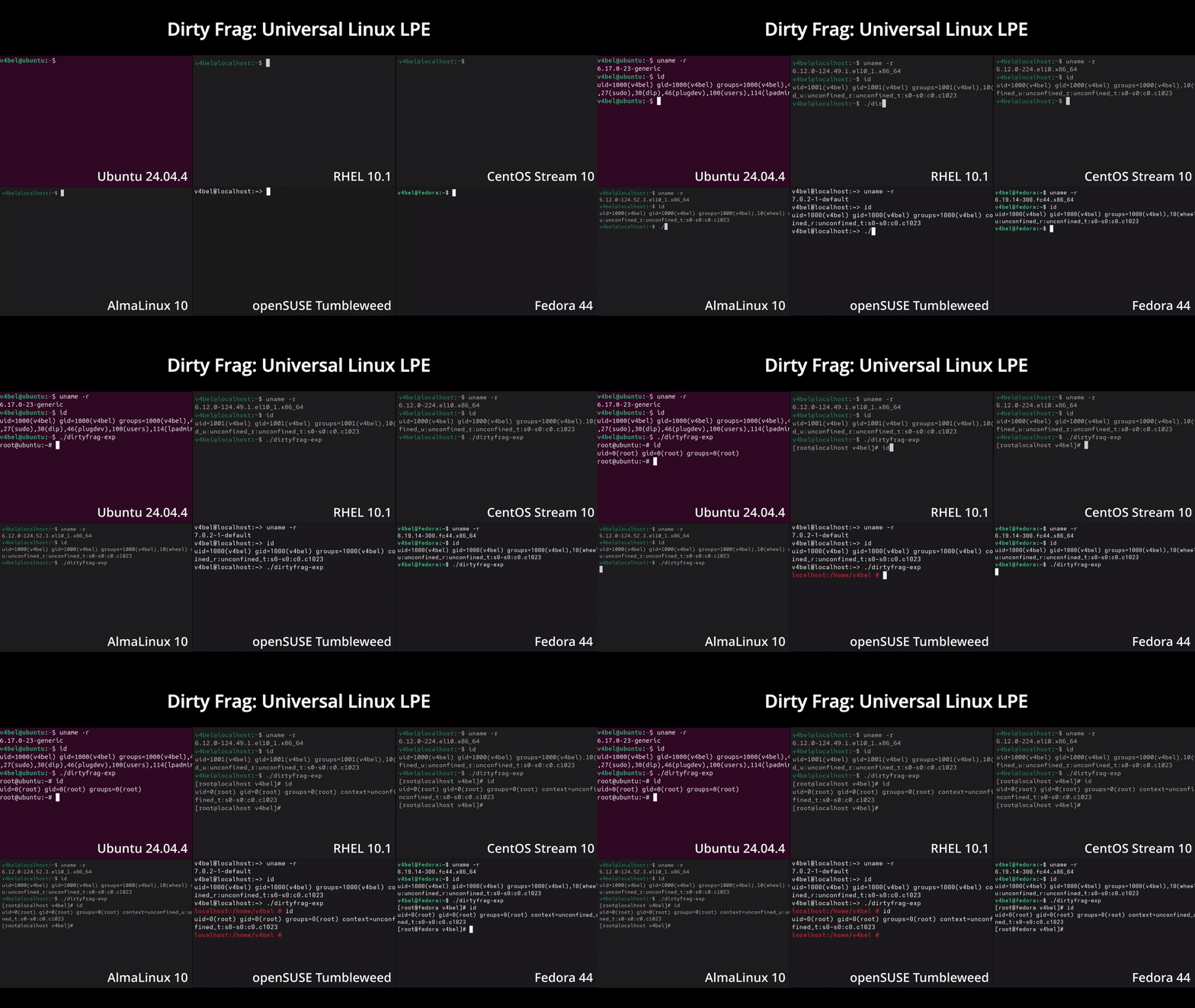
Here is a demonstration of what it can do:
Why the “local only” caveat doesn’t protect you

Here’s the assumption that quietly kills servers in 2026: “My SSH is locked down with keys, fail2ban, and a non-standard port. Attackers can’t even get a shell, so a local exploit doesn’t matter.”
The assumption is wrong because attackers don’t need to come through your front door anymore. The realistic compromise chain in 2026 looks like this:
- A WordPress plugin you forgot you installed has an unauthenticated RCE.
- The attacker gets a
www-datashell. - They fingerprint your kernel in under a second.
- They drop a Dirty Frag PoC pulled from a public repo.
- They’re root. Persistence is installed before you’ve finished your coffee.
The shell doesn’t come from SSH. It comes from the application layer — a Docker container escape, a CI runner with a leaked token, a Composer dependency with a backdoor, a misconfigured n8n webhook, a Gitea instance behind on patches. Self-hosters tend to run a lot of services, and each one is a candidate foothold.
Once any of them pops, Dirty Frag turns “they got into my blog” into “they own my server, my database, and every secret in every .env file the box can read.”
The KVM isolation point most posts skip

Here’s something worth understanding if you’re choosing infrastructure, not just patching it.
Not every product labelled “VPS” gives you the same blast radius when a kernel bug fires.
On a KVM VPS — what we run at VPS.US, and what most serious self-hosters should be on — each instance has its own dedicated kernel. If Dirty Frag is exploited inside your VPS, the attacker gets root in your VPS. They don’t get the hypervisor. They don’t get your neighbours. The damage stays inside the box you control. That’s still bad, but it’s bounded.
On OpenVZ, LXC, or other shared-kernel container products, all tenants share the host kernel. A kernel-level escalation there is a much scarier event — the same bug can compromise the entire host node and everything running on it. This is why “VPS” pricing that looks suspiciously cheap usually involves a shared kernel underneath the marketing.
This isn’t a sales pitch. It’s the threat model. If you’re running anything that matters on a shared-kernel container product, Dirty Frag is a fine reason to migrate.
What to do right now, in priority order
Skip the abstract advice. Here’s the actual checklist.
1. Patch your kernel today
Every major distribution has shipped fixes: Ubuntu, Debian, AlmaLinux, Rocky, RHEL, CloudLinux.
# Debian / Ubuntu
sudo apt update && sudo apt upgrade

# RHEL / Alma / Rocky
sudo dnf update kernel

# Then reboot. Live-patching (kpatch, livepatchd, KernelCare) can avoid the
# reboot, but only if you're already subscribed.
sudo reboot
After reboot, verify:
uname -r
# Compare against your distro's advisory for the fixed version.
If you’re on a managed VPS where the provider handles kernel patching, confirm with them that the rollout has actually happened on your node. Don’t assume.
2. Disable the vulnerable modules if you can’t patch immediately
If you have a maintenance-window problem — say, a database that hates being rebooted mid-day — you can blunt the attack surface temporarily:
# Block module loading on next boot
echo "install esp4 /bin/false"  | sudo tee /etc/modprobe.d/disable-esp4.conf
echo "install esp6 /bin/false"  | sudo tee /etc/modprobe.d/disable-esp6.conf
echo "install rxrpc /bin/false" | sudo tee /etc/modprobe.d/disable-rxrpc.conf

# Unload now if currently loaded
sudo rmmod esp4 esp6 rxrpc 2>/dev/null || true
The trade-off: if you use IPsec VPNs, this breaks them. Most self-hosters don’t — WireGuard is a fine alternative and isn’t part of this exploit chain. RxRPC is almost certainly unused unless you’re running AFS, which you’d know about.
3. Tighten unprivileged user namespaces
This kills one of the major exploitation paths for the Fragnesia variant:
sudo sysctl -w kernel.unprivileged_userns_clone=0
# Persist
echo "kernel.unprivileged_userns_clone=0" | sudo tee /etc/sysctl.d/99-hardening.conf
The trade-off: rootless Docker breaks. Podman in rootless mode breaks. Flatpak and AppImage sandboxing break. If you’re running rootful Docker (most self-hosters still are), this is free. If you’ve deliberately set up rootless containers, you’ll need to weigh the security gain against the operational loss.
4. Audit what can execute code on your box
Dirty Frag needs a foothold. The smaller you make the set of things that can run code as any user, the less the kernel bug matters. This is the boring work, and it pays off for every future kernel CVE, not just this one:
- Remove the SSH keys of contractors who finished their gig three months ago.
- Audit
docker psfor containers running as root that don’t need to be. - Disable WordPress XML-RPC and the REST API endpoints you don’t use.
- Check whether your CI runner’s deploy token has shell-equivalent permissions.
- Trim
sudoersto only the accounts that need it.
5. Review Your Security Practices.
We would never reminder enough to watch for your security as LLM rises and discover new vulnerabilities. Protect yourself with the best practices. It doesn’t take much time and would save you from vulnerabilities or delay intrusion giving you time to update.
If you run Linux VPS infrastructure, these guides are worth reviewing:
- Essential VPS Security Practices to Protect Your Virtual Server
- Top VPS Security Questions Answered by Experts
- 7 SSH Key Security Best Practices
- Post-Quantum SSH: Preparing for the Next Era of Infrastructure Security
How to tell if you’re already compromised

Dirty Frag manipulates page cache directly, so disk-based forensics can miss it in the moment. Things to look for:
- New users in
/etc/passwdor unexpected drop-ins under/etc/sudoers.d/ - SSH keys you didn’t add in any user’s
~/.ssh/authorized_keys, including root - Cron jobs you didn’t write, especially in
/etc/cron.d/and user crontabs - Outbound connections you don’t recognise (
ss -tunap) - Modified SUID binaries:
- Gaps or unfamiliar source IPs in
lastandlastb
If you find any of that, the honest answer is: rebuild from a known-good snapshot, rotate every credential the server has touched (SSH keys, API tokens, database passwords, every secret in every .env file), and treat any connected service as compromised until proven otherwise. Patching after a confirmed compromise doesn’t undo what the attacker already did.
Frequently Asked Questions
Does Dirty Frag affect Windows VPS?
Can I patch without rebooting?